 EN
EN
 INA
INA
Three Udayana University Physics Students Join BRIN's Impactful Research Internship Program
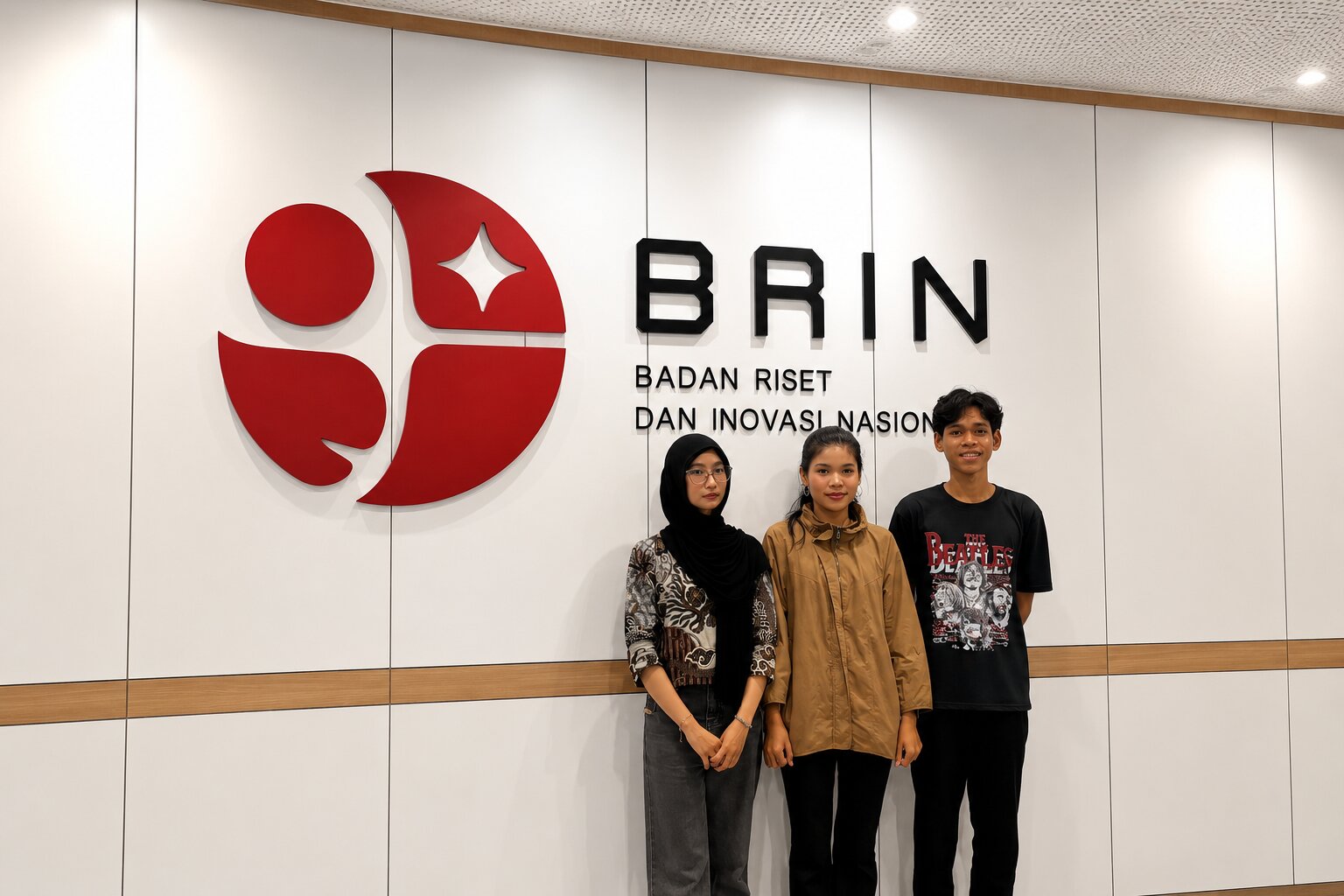
Jakarta – Three undergraduate students from the Physics Study Program, Faculty of Mathematics and Natural Sciences (FMIPA), Udayana University, have demonstrated their commitment to scientific research by participating in the Impactful Research Internship Program (Magang Riset Berdampak) at the National Research and Innovation Agency (BRIN) during the Even Semester of the 2025/2026 Academic Year.
The students, Surya Candra Kartika, Selviana Cahyaningtyas, and Agnes Viola Saragih, are sixth-semester undergraduates specializing in Materials Physics and Optoelectronics. Sharing a strong passion for nanomaterials and their technological applications, they embraced this internship as an opportunity to deepen their research expertise while experiencing the real-world environment of scientific research.
Throughout the internship, each student pursued a research project addressing current challenges and emerging opportunities in nanomaterials.
Surya Candra Kartika focused on the synthesis of black TiO2 for the photodegradation of methylene blue, aiming to develop highly efficient photocatalytic materials for environmental remediation, particularly in wastewater treatment.
Selviana Cahyaningtyas conducted research on the application of Au/Ag nanostructures for biosensing, exploring plasmonic materials capable of enabling highly sensitive and selective detection of biological molecules.
Meanwhile, Agnes Viola Saragih investigated the synthesis of plasmonic gold-silver core-shell nanoparticles, an advanced nanomaterial with promising applications in optical sensing, biosensors, photonic devices, and other cutting-edge technologies.
These research topics represent important areas within nanomaterials and nanotechnology, one of the fastest-growing fields in modern physics and materials science with significant impacts on healthcare, environmental sustainability, renewable energy, and advanced sensing technologies.
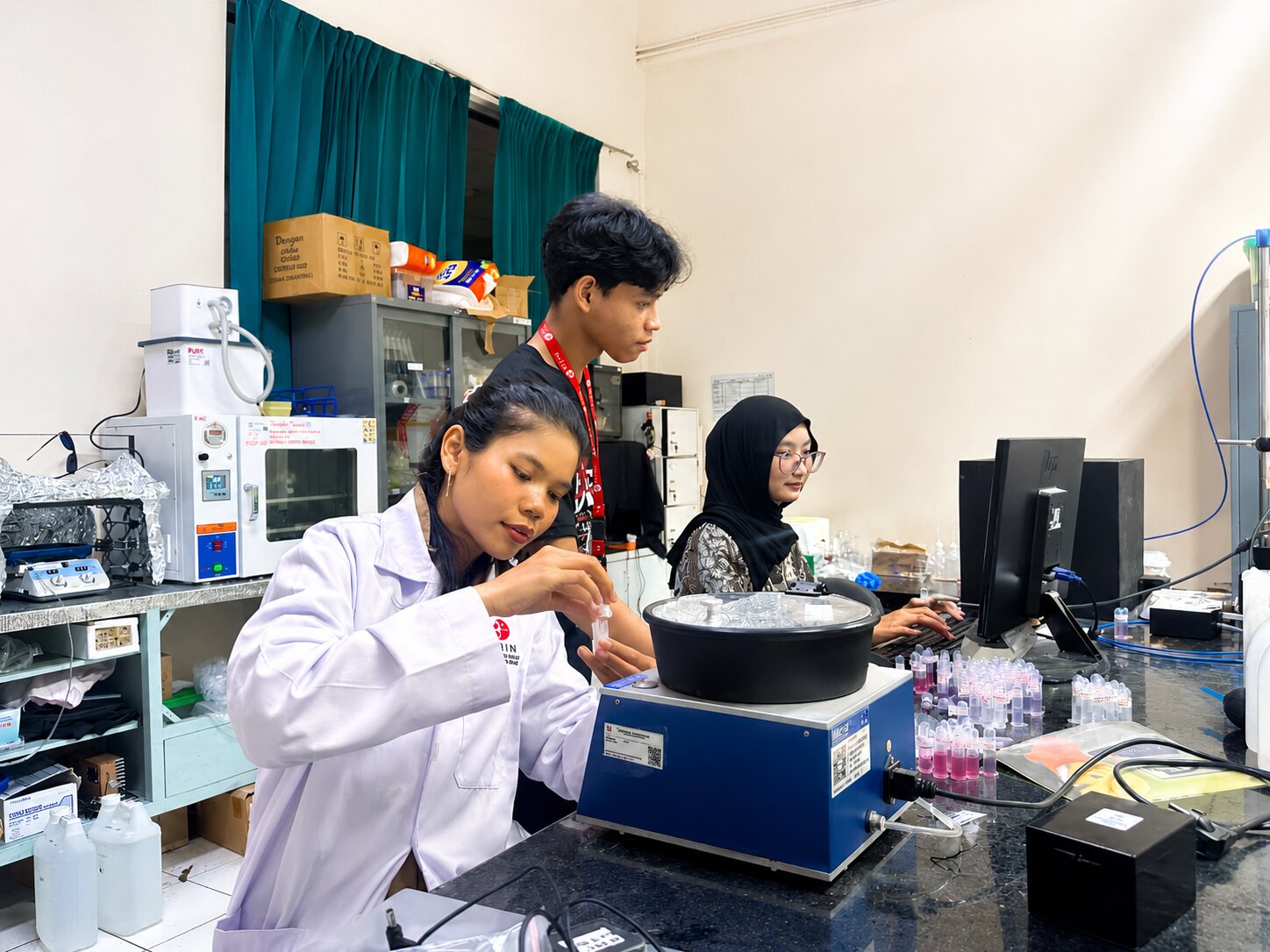
Beyond gaining academic knowledge, the internship provided invaluable opportunities for students to experience professional research firsthand. At BRIN, they worked with state-of-the-art research facilities and advanced scientific instrumentation, allowing them to perform experiments using techniques and equipment commonly employed in world-class research laboratories.
In addition, they collaborated closely with experienced BRIN researchers who served as mentors throughout the research process. This collaboration enabled the students to understand every stage of scientific research—from literature review and experimental design to data analysis, interpretation of results, and scientific reporting—within a professional research environment.
The program also contributed significantly to the development of both technical (hard) skills and professional (soft) skills. Students strengthened their competencies in nanomaterial synthesis, laboratory techniques, scientific data analysis, and research methodologies, while simultaneously improving critical thinking, teamwork, communication, time management, and problem-solving abilities.
For the participants, the internship was far more than an academic requirement; it became a transformative learning experience that bridged classroom knowledge with real scientific practice. Such authentic research experiences are difficult to obtain through conventional coursework alone.
The participation of these students reflects the strong commitment of the Physics Study Program, FMIPA Udayana University, to promoting research-based education and preparing graduates who are innovative, adaptable, and globally competitive. Programs such as the BRIN Impactful Research Internship play a vital role in nurturing future physicists capable of contributing to scientific advancement and technological innovation.
The Physics Study Program encourages more students to take advantage of research internship opportunities at BRIN and other leading research institutions. These experiences not only broaden scientific knowledge but also provide valuable preparation for postgraduate studies, research careers, and employment in technology-driven industries.
FACULTY OF MATH AND NATURAL SCIENCES